Home › Worlds & Places › Mars
At a glance
Mars is the second most important world in the Imperium and, in the eyes of its own priesthood, the first. It is the homeworld of the Adeptus Mechanicus, the techno-religious empire that builds the Imperium's starships, Titans, tanks and guns. Its surface is a planet-wide factory, scarred by millennia of mining, smelting and war, and its sky is choked with the smoke of countless forges. The Martian priesthood worships the Machine God, whose avatar on earth they call the Omnissiah, and they regard knowledge itself as a sacred relic to be hoarded, protected and only rarely shared.
Mars is not ruled by Terra in any simple sense. Its relationship with the Imperium rests on the Treaty of Olympus, a pact sealed between the Emperor and the Martian priesthood during the Unification Wars. Under that treaty, Mars supplied the Great Crusade with weapons, ships and engineers, while keeping its own laws, its own faith and its own armies. Ten thousand years later, the Fabricator-General of Mars still sits among the High Lords of Terra, and the Imperium still cannot survive without the products of the Red Planet.
Mars has also been a battlefield. During the Horus Heresy it tore itself apart in the Schism of Mars, a civil war between loyalist tech-priests and the Dark Mechanicum that left whole regions as radioactive glass. Those scars have never fully healed, and beneath the surface lies something older and stranger than any human war.
Geography & environment
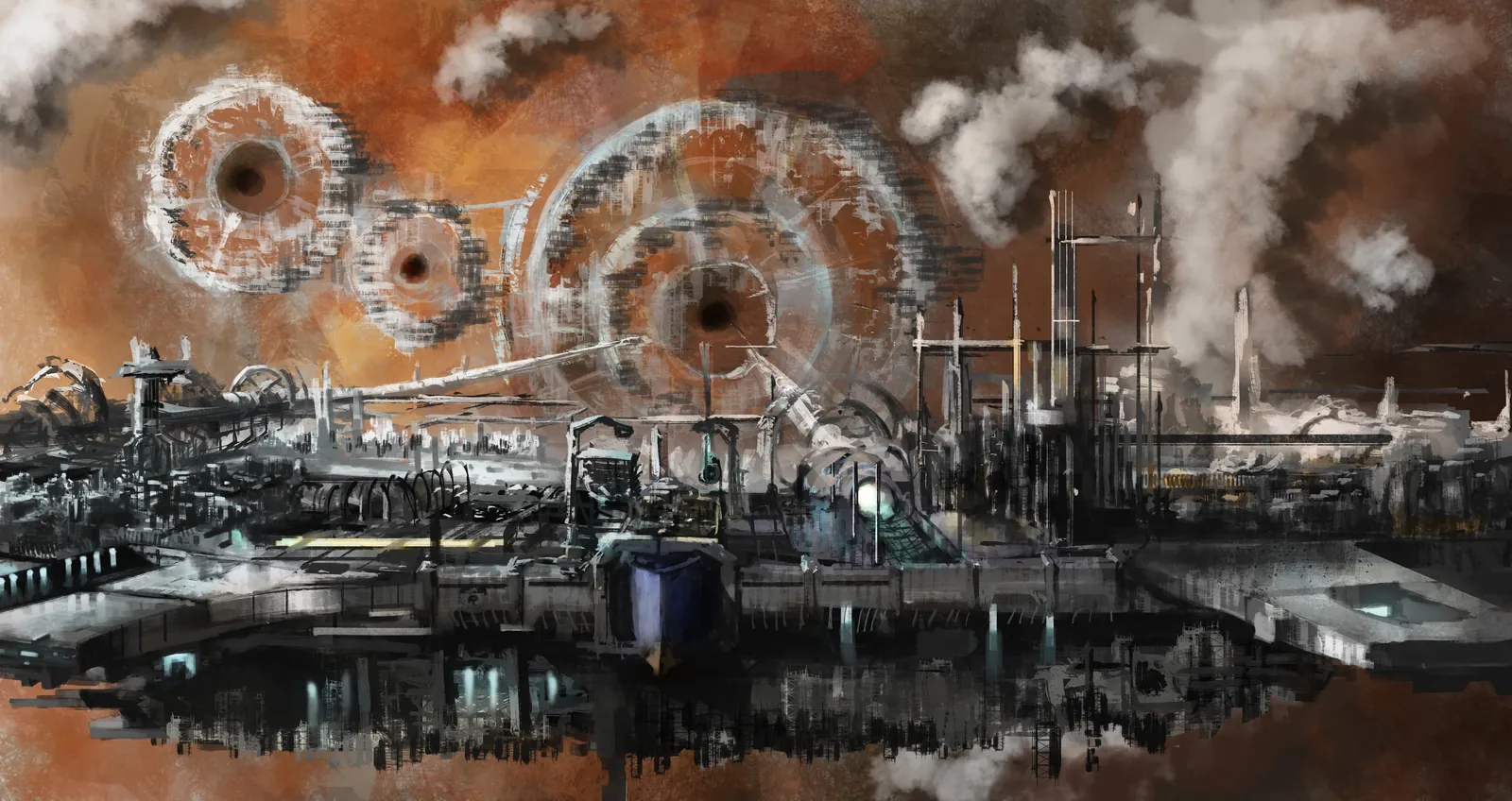
From space Mars still glows red, but the colour is now the glare of furnaces as much as the rust of its ancient deserts. Atmospheric processors keep its air barely breathable in some regions, while others are toxic, freezing or simply vacuum. Its surface is covered in forge-temples, manufactoria and habitation stacks, connected by rail lines, maglev causeways and void-shielded roads. Industrial waste has been piled into mountains, and great canyons have been carved by mining that has gone on without pause since before the Age of Strife.
The most famous landmark is Olympus Mons, the great volcano that is the spiritual and political centre of the Martian priesthood. Its slopes are covered in temples, data-vaults and the palace of the Fabricator-General. The volcano lends its name to the Treaty of Olympus, signed there when the Emperor first came to Mars.
Across the Tharsis plateau and the great plains spread the forges that feed the Imperium. Each is effectively its own city-state, ruled by a Magos and specialising in particular technologies, from lasgun power packs to the cores of plasma reactors. Some forges are dedicated to the building of Titans, and the Titan Legions of Mars maintain their own fortress-temples where the god-engines are housed between wars.
The most secret place on Mars is the Noctis Labyrinth, a vast maze of canyons and tunnels that the priesthood has sealed off for millennia. Few within the Mechanicus know what it contains. Those who do whisper that the Labyrinth holds the remains of the C'tan known as the Void Dragon, imprisoned there in ages long past, and that some of the strangest technologies of Mars have been drawn from its prison. Whether this is the true origin of the Martian faith is one of the most dangerous questions in the galaxy, and those who ask it too loudly tend to disappear.
Mars also has two small moons, Phobos and Deimos, both heavily fortified and dedicated to the needs of the forges, and the orbital docks above the planet are among the largest in the Segmentum Solarum. The Ring of Iron, a vast circle of shipyards around Mars, has produced warships for the Imperial Navy for ten thousand years.
History
Before the Emperor
Mars was colonised in the earliest days of human expansion into space, and during the Dark Age of Technology it became a centre of research and industry. When the Age of Strife cut it off from the rest of humanity, Mars endured as a closed society of tech-priests who preserved what they could of the old knowledge. They came to see technology itself as divine, the gift of a Machine God whose will could be divined in the workings of every engine. Over centuries of isolation and decline, the cult hardened into a priesthood with strict hierarchies, elaborate rituals and a deep fear of innovation without precedent.
The Treaty of Olympus
When the Emperor completed the conquest of Terra, he turned to Mars. Rather than conquer it, he came to the priests in person and, according to Martian legend, they recognised him as the Omnissiah, the Machine God made flesh. The Treaty of Olympus was signed. Mars swore its support to the Emperor's cause, and in return its independence, its laws and its faith were guaranteed. The Mechanicum, as it was then known, became the forge of the Great Crusade. Its explorators accompanied the Legions and its engineers built the fleets that carried humanity back out into the stars.
The Schism of Mars
The Horus Heresy broke the Martian priesthood. The Fabricator-General, Kelbor-Hal, had long resented the restrictions the Emperor placed on Martian research. When Horus offered him the freedom to pursue forbidden knowledge, Kelbor-Hal took it. He unleashed a terrible scrapcode virus across the planet's data-networks, turning servitors, forges and even Titans against their masters. Loyalist forges were overrun, and Mars descended into a savage civil war.
Loyalist magi such as Koriel Zeth of Magma City fought to save the forges, but much of Mars fell to the traitors, who would become the Dark Mechanicum. The Titan Legion Legio Mortis turned traitor, while loyalist Legions such as the Legio Ignatum fought their former brothers across the plains. When the traitors finally left Mars to join Horus, they took with them countless war machines that would be turned against Terra itself. After the Heresy, Mars was retaken and purged, but many forges never rebuilt.
The long millennia
In the ten thousand years since the Heresy, Mars has remained the heart of the Adeptus Mechanicus. It has survived internal power struggles, schisms over doctrine and attacks from outside, including incursions in the War of the Beast. The Fabricator-General's seat among the High Lords has made Mars a permanent player in Terran politics, and its priests have learned to bargain hard for every concession they make to the Imperium.
The Era Indomitus
When the Great Rift opened, the Sol System was battered by warp storms and daemonic incursions. Mars suffered with the rest. Yet it was Martian genius, in the form of Archmagos Belisarius Cawl, that gave the Imperium its greatest new weapon. Cawl's ten-thousand-year project to create the Primaris Space Marines was revealed when Roboute Guilliman returned, and the Indomitus Crusade was armed in large part from the forges of the Red Planet.
The Machine God and the Omnissiah
The faith of Mars is older than the Imperium. Its central belief is that the Machine God, a divine intelligence, is present in all technology, and that knowledge is the way to approach it. The Omnissiah is the Machine God's avatar in the material world, and the Martian priesthood officially teaches that the Emperor is that avatar. The Motive Force, the energy that animates every machine, is held to be the Machine God's breath.
Every machine has a machine spirit that must be respected. Before a tank is started, a tech-priest may anoint its engine with oils and recite litanies. Before a weapon is fired, its spirit may be soothed with prayer. Imperial soldiers who know nothing of Martian theology still pray to their lasguns, a habit learned from the priests who maintain their equipment.
The Martian faith treats flesh as weak and machine as strong. Its priests replace their bodies piece by piece with augmetics, and the highest magi are more machine than human. Their speech becomes binaric cant, their emotions are suppressed and their minds are expanded with data-implants. To an outsider, the result can look like a slow suicide; to a tech-priest, it is the path towards holiness.
People & culture
Martian society is rigidly ordered. At the top are the magi, the senior tech-priests who have replaced most of their flesh with machinery and see the human body as weak and impure. Beneath them are countless tech-priests and adepts, then the soldiers of the Skitarii, and at the bottom an enormous population of menials, labourers and lobotomised servitors who keep the forges running.
Religion is everything. Every act of maintenance is a prayer, every machine has a spirit that must be appeased with incense, sacred oils and binary chants. Knowledge is treated as a holy relic; the greatest prize for any tech-priest is a fragment of a Standard Template Construct, the lost blueprints of the Dark Age of Technology. Innovation is viewed with suspicion, and many magi would rather spend centuries searching for a lost design than risk creating a new one.
Despite their unity of faith, the Martian priests are deeply divided. Rival forges compete for resources, prestige and influence. Some magi believe the Omnissiah and the Emperor are one and the same; others quietly believe the Omnissiah is a separate deity entirely. These divisions rarely spill into open war, but they colour everything that happens on the Red Planet.
Defenders & war-machine
Mars is one of the most heavily defended worlds in the galaxy. Its Skitarii legions number in the millions, from Skitarii Rangers and Skitarii Vanguard to the assassins of the Sicarian Infiltrators. The forges maintain battle-automata such as the Kastelan Robots, and the Titan Legions of Mars, including the Legio Ignatum, field Warlord Titans and greater engines still.
Above the planet orbit the warships of the Martian fleet and the docks of the Ring of Iron. The Ordo Reductor, the Mechanicus's own artillery specialists, have their great siege engines on Mars, and the Mechanicus also maintains the Electro-Priests and other fanatics who answer only to the Cult.
Forges & landmarks
Olympus Mons
The greatest volcano in the Sol System is the throne of the Martian priesthood. Its flanks are terraced with temples and data-shrines, its caldera holds the seat of the Fabricator-General, and its slopes are crowded with pilgrims from forge worlds across the galaxy who come to pray where the Treaty of Olympus was sealed. The priesthood regards the mountain as the closest place to the Machine God that exists in the material universe.
Magma City
Built into the volcanic regions of the Tharsis Montes, Magma City was one of the great forges of Mars in the age of the Great Crusade. Under Fabricator-Locum Koriel Zeth it was a centre of bold research, and its rivers of lava were harnessed to power its manufactoria. Its stand and eventual fall during the Schism made it one of the most remembered battlefields of the Red Planet.
The Ring of Iron
Above Mars hangs a colossal network of orbital shipyards, foundries and dry docks known as the Ring of Iron. Battleships, cruisers and Ark Mechanicus vessels are constructed here over decades, their hulls rising slowly in the vacuum while thousands of servitors and adepts crawl across them. The Ring is one of the Imperium's most precious strategic assets, and its defences rival those of Terra's own orbital platforms.
The vaults of knowledge
Throughout Mars lie sealed archives where the priesthood keeps its most precious data: fragments of Standard Template Constructs, records of lost technologies and the accumulated rites of ten thousand years. Many vaults are forbidden even to senior magi. Some are said to contain weapons so dangerous that their very designs were declared heretical, kept only so that the Mechanicus can recognise them if they ever reappear.
The Titan Legions of Mars
The god-machines of the Collegia Titanica are the most terrifying weapons the Mechanicus can bring to war. Several Titan Legions call Mars home, the most famous being the Legio Ignatum, the Fire Wasps, who have fought for the Imperium since the Great Crusade and stood against their traitor kin during the Schism. Titans are piloted by Princeps, who are wired directly into their machines and share their aggressive machine-spirits, and they are revered as avatars of the Omnissiah's wrath.
The betrayal of the Legio Mortis, the Death's Heads, during the Heresy remains one of the darkest moments in Martian history. The traitor Legion fought on Mars, at Isstvan, on Beta-Garmon and finally at the Siege of Terra, and its engines are said to still stalk the battlefields of the Eye of Terror, corrupted by the warp into things that are as much daemon as machine.
Notable battles
- The Schism of Mars (M30-M31): loyalist and traitor tech-priests fight a planet-wide civil war during the Horus Heresy.
- The Battle of Magma City: Koriel Zeth's forge holds out against the traitor Legio Mortis and Dark Mechanicum for a time before it falls.
- The War of the Beast (M32): the Ork onslaught that threatens the whole Sol System, including the Martian forges.
- The Era Indomitus (M42): Mars arms the Indomitus Crusade, while its priests fight daemonic incursions in the Sol System.
Trivia
- The Mechanicus cog-and-skull symbol, half flesh and half machine, represents the dual nature of a priesthood that serves both the Emperor and the Machine God.
- Many Martian magi claim to remember events from the Dark Age of Technology, preserved in data-stacks older than the Imperium.
- Mars retains its own legal and religious autonomy, and Imperial officials can enter only with the consent of the priesthood.
- The Treaty of Olympus is still recited as one of the founding documents of the Imperium.


