Home › Worlds & Places › Holy Terra
At a glance
Holy Terra is the world where humanity began, and it is the beating heart of an empire of a million worlds. Every Imperial citizen, from a hive-ganger on Necromunda to a Cardinal on Ophelia VII, is taught that Terra is sacred ground, because the Emperor of Mankind sits upon it in the Golden Throne, a husk of a god kept alive by archeotech and the daily sacrifice of psykers. Pilgrims cross the galaxy for a lifetime just to glimpse the walls of his Palace, and most die before they arrive.
Very little of the original planet survives. Its oceans were lost in the wars of Old Night, its mountains were carved into fortresses and its plains were buried under strata of hive cities, archives and shrines. What remains is a world-sized monument, layered and crumbling, administered by the largest bureaucracy in human history. From here the High Lords of Terra issue decrees that may take centuries to reach their targets, the Astronomican beacon pierces the warp so that Navigators can steer, and the Black Ships return with their cargo of young psykers.
Terra is the first and last line of the Imperium. It has burned once, during the Siege of Terra at the end of the Horus Heresy, and the scars are still worshipped as relics. If it falls again, the Imperium falls with it.
Geography & environment
From orbit, Terra is a grey-brown sphere banded with the lights of endless cities. The old seas are gone, boiled away or drained during the Age of Strife and the industrial excesses that followed, leaving vast ash-dry basins that have since been filled with habitation sprawl, landing fields and polluted lowlands. The air is thick, filtered by colossal atmospheric processors, and the sky over many regions never clears of smog.
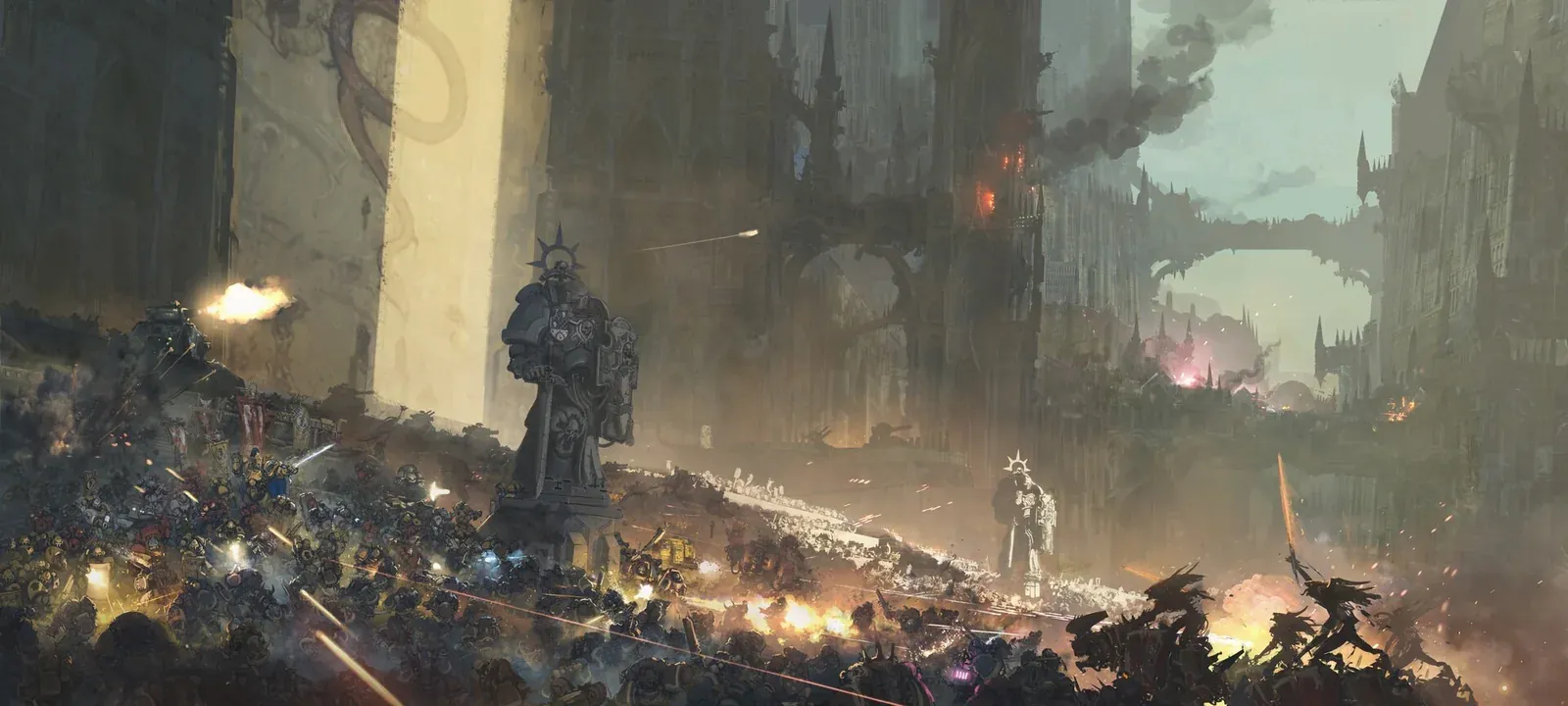
The dominant feature of the planet is the Imperial Palace. It was raised on and around the Himalazian massif, the highest mountains of old Earth, and over ten millennia it has grown into a continent-spanning complex of walls, bastions, chapels, dormitories, hangars and archives. Whole districts within it have been forgotten for centuries. The Palace is not one building but a nation in its own right, with its own spaceports, standing armies and population numbering in the billions, nearly all of whom serve the Adeptus Terra in some form.
At the core of the Palace lies the Sanctum Imperialis, and within it the Throne Room where the Emperor sits. Beneath it run the Imperial Dungeon and the half-finished webway gate the Emperor once intended as humanity's road to the stars without the warp. Around the Sanctum stand monuments with names every Imperial schola child learns: the Eternity Gate, the Lion's Gate spaceport, the Delphic Battlement, the Ultimate Wall and the Hall of Victory. Some are original, some rebuilt, and many were reconsecrated after the Heresy as shrines to the dead.
Beyond the Palace, Terra is a planet of hive cities and districts whose names hint at ancient nations long lost: the Ecclesiarchal Palace, seat of the Ecclesiarch and the Ministorum; the sprawling records-halls of the Administratum; the estates of the Navigator Houses of the Navis Nobilite; and the towering fortresses of the Adeptus Astra Telepathica. In the unlit depths beneath the hive layers lie ruins from every previous age of human history, explored only by tech-priests, scavengers and the desperate.
Terra's moon, Luna, is just as heavily built upon. In the Dark Age of Technology it was a cradle of gene-science, and during the Great Crusade it was the domain of the Selenar gene-cults. The Sisters of Silence and other orders have had strongholds there, and Luna's orbital docks have served the fleets of the Segmentum Solar for millennia.
History
Cradle of humanity
Humanity's history on Terra stretches back far beyond the Imperium's records. In the Dark Age of Technology, mankind spread across the stars from Terra using early warp drives and sleeper ships, building a golden civilisation served by thinking machines. That age ended in catastrophe: the rebellion of the Men of Iron, the eruption of psychic mutation and, finally, the birth of Slaanesh, whose screams tore warp storms across the galaxy and cut human worlds off from one another. Terra was left alone in the dark.
Old Night and the Unification Wars
The Age of Strife on Terra was a nightmare of techno-barbarian warlords, mutant tribes and terror weapons. Gene-crafted armies, rad-wastes and psychic horrors made the old nations of Earth into hellscapes ruled by petty tyrants such as the masters of the Ethnarchy, Gog, and the Panpacific warlords. Into this chaos stepped the Emperor, a being who claimed to have walked among humanity in secret for millennia. With his Thunder Warriors, gene-forged super-soldiers who preceded the Space Marines, he waged the Unification Wars, crushing one warlord kingdom after another until all of Terra answered to him.
The Thunder Warriors were then discarded, their unstable gene-craft making them unfit for the galactic conquest to come, and the Emperor turned his eyes outward. He forged the Treaty of Olympus with the Mechanicum of Mars, trading recognition of the Red Planet's independence for its forges and fleets, and from Terra he launched the Great Crusade.
The Great Crusade and the Heresy
For two centuries the Imperium expanded at a staggering rate, its Legiones Astartes led by the Primarchs the Emperor recovered one by one. Terra was the administrative centre of it all, but the Emperor increasingly left the Crusade in the hands of his sons. After the Triumph at Ullanor he returned to Terra to complete his secret webway project, leaving Horus Lupercal as Warmaster. The webway effort was ruined when Magnus the Red broke through the Emperor's wards with a desperate psychic warning, letting the daemons of the warp into the Imperial Dungeon. Custodians, Sisters of Silence and the Emperor himself fought in the tunnels beneath the Palace while Malcador the Sigillite took the Emperor's place on the Golden Throne to hold the breach shut.
Then Horus came. The Siege of Terra was the largest battle the Imperium has ever fought. Rogal Dorn had turned the Palace into a fortress, and for months the traitor Legions, daemons and the Dark Mechanicum battered at its walls. Sanguinius held the Eternity Gate, the Lion's Gate spaceport fell and was retaken, and the Palace's outer defences were lost one after another. At the end, the Emperor teleported aboard the Vengeful Spirit, where Horus slew Sanguinius before being destroyed utterly by his father. The Emperor was carried back, mortally wounded, and placed in the Golden Throne, where he has remained ever since.
Ten thousand years of the Throne
In the long centuries after the Heresy, Terra became the seat of the High Lords, a council of the most powerful officials of the Adepta. The Emperor's silence turned him into a god, and the Imperial Cult became the state religion. Terra endured the Ork invasion of the Beast in the 32nd millennium, when Ork attack moons appeared in the Sol System and the Imperium came close to collapse. It endured the Reign of Blood in the 36th millennium, when High Lord Goge Vandire ruled Terra as a mad tyrant until Sebastian Thor and the Sisters of the Order of the Ebon Chalice turned on him, ending the Age of Apostasy. It endured endless intrigues, assassinations and purges among the High Lords.
The Era Indomitus
When the Great Rift tore across the galaxy at the end of the 41st millennium, Terra was nearly overwhelmed. Psychic storms battered the Astronomican, daemons manifested in its shadow and the Imperium was split in two. Roboute Guilliman, resurrected after ten thousand years, fought his way to Terra through the warp and entered the Throne Room to stand before his father. He emerged as Lord Regent of the Imperium and launched the Indomitus Crusade from the Throneworld, bringing the Primaris Space Marines forged by Belisarius Cawl to a galaxy on fire.
People & culture
Terra's people are almost all servants of the Imperium. Most are scribes, archivists, menials, labourers, functionaries, pilgrims and soldiers. Generations live and die inside a single department of the Administratum, copying records that may never be read. The Palace and the great Adepta are effectively hereditary, with families serving the same office for millennia.
Religion saturates daily life. The Ecclesiarchy is headquartered on Terra and countless shrines mark the places where heroes of the Siege fell. Pilgrims arrive in their millions, and Terra must import enormous quantities of food and water simply to keep its population alive. Pilgrim fleets are often stripped of anything valuable before their passengers are allowed to set foot on the holy soil.
The most chilling Terran tradition is the feeding of the Throne. Every day, psykers gathered from across the galaxy by the Black Ships are sacrificed to sustain the Emperor and to power the Astronomican, whose Choir of thousands of sanctioned psykers focuses the beacon. For most of these psykers, journeying to Terra means a death sentence they are told is the highest honour.
Defenders & war-machine
Terra is guarded by the Adeptus Custodes, the Emperor's personal bodyguard, under their Captain-General, a post once held by Constantin Valdor and now by Trajann Valoris. Each Custodian Guard is a demigod gene-crafted individually by the Emperor's methods, and their numbers are kept small. Alongside them stand the Sisters of Silence, the null-maiden Pariahs whose presence is anathema to psykers and daemons.
During and after the Heresy, the Imperial Fists under Rogal Dorn were the Palace's defenders, and their successors still return to fight for Terra in times of crisis. Terra is also home to the Adeptus Arbites' greatest courts, the Officio Assassinorum's temples, the Inquisition's highest councils and the Imperial Navy's Solar fleet. In practice, every single faction of the Imperium maintains its own forces on or around the Throneworld, and their rivalries are as dangerous as any external enemy.
Landmarks of the Throneworld
The Sanctum Imperialis and the Throne Room
The innermost heart of the Palace is a fortress within a fortress. Only the Custodians, a handful of the highest Adepts and the rare visitor granted audience may pass its gates. The Throne Room itself is described as a vast, dim chamber filled with the hum of machinery, the chanting of tech-priests and the presence of the Emperor, whose withered body is wired into the Golden Throne. Those who have stood before him speak of an overwhelming psychic weight, a sense of being seen by something far greater than a man.
The Astronomican
The Astronomican is the psychic lighthouse that makes interstellar travel possible. Its focus is the Emperor, amplified by the Choir of the Astronomican, an order of thousands of psykers housed in a great mountain-top complex. The beacon reaches across most of the galaxy, though its strength falls away towards the fringes and it is blotted out entirely by warp storms. When the Astronomican falters, ships are lost by the thousand, and the Great Rift showed how quickly the whole Imperium can be plunged into darkness.
The Lion's Gate and the Eternity Gate
The Lion's Gate was the largest spaceport on Terra during the Heresy, a mountain of rockcrete and adamantium that served as one of the Palace's main bastions. The Eternity Gate was the great door to the Sanctum Imperialis. Both were the scenes of the most desperate fighting of the Siege, and both remain sites of pilgrimage and military ceremony.
The Imperial Dungeon
Hidden beneath the Palace is the Imperial Dungeon, the subterranean complex where the Emperor's webway project was built. The breach Magnus caused here was eventually sealed, but the Dungeon remains one of the most secretive places in the Imperium. Rumours say that daemons still hammer at the sealed gates, and that the Custodes have never stopped guarding them.
The Senatorum Imperialis
The great council chambers where the High Lords of Terra meet are among the most lavish places in the Palace. Here the Masters of the Administratum, the Ecclesiarch, the Fabricator-General of Mars, the Grand Master of Assassins, the Master of the Astronomican and the other High Lords argue over the fate of entire sectors, often more concerned with their own power than the needs of the Imperium.
Notable battles
- The Unification Wars (M30): the Emperor's conquest of Terra's techno-barbarian kingdoms with the Thunder Warriors.
- The Siege of Terra (014.M31): Horus Lupercal's assault on the Imperial Palace; see the full battle page.
- The War of the Beast (M32): the Ork Waaagh! that brought attack moons to the Sol System and nearly ended the Imperium.
- The Reign of Blood (M36): civil war on Terra ending with the downfall of Goge Vandire.
- The Great Rift crisis (M41/M42): daemonic incursions in the Sol System as the Cicatrix Maledictum opened, ended only by Guilliman's arrival and the Indomitus Crusade.
Trivia
- Terra was once called Earth, a name almost no Imperial citizen now recognises.
- The Emperor has not spoken in ten thousand years, yet his will is said to be interpreted by the Adeptus Custodes and certain psykers of the Astronomican.
- The Palace contains whole districts that have been lost to the records, and some scholars believe portions of the Siege-era defences are still occupied by forgotten garrisons.
- Pilgrims who reach Terra often never see the Palace at all, because it is closed to all but the most exalted.
- In the Siege, the Hall of Victory and the Delphic Battlement were among the last lines before the Sanctum, and their ruins are still venerated.


