Home › Great Battles › The Siege of Terra
 1 / 8 · Click to enlarge
Background
By the time the traitor fleets broke into the Sol System, the Horus Heresy had already cost the Imperium more than any war in its history. Isstvan had gutted three loyal Legions in a single afternoon. Calth had burned. Prospero lay in ash. Across the galaxy, brother had turned on brother for seven bitter years, and every one of those campaigns had been a step on the road to a single destination: Terra, the cradle of humanity and the seat of the Emperor himself.
Horus Lupercal, once the favoured son and Warmaster of the Great Crusade, now marched at the head of nine traitor Legions and the daemon-haunted hosts of Chaos. He understood that the war could not be won by attrition. Guilliman's Ultramarines, the Lion's Dark Angels and the Space Wolves were all racing towards Sol; if they arrived before the Palace fell, the rebellion would be crushed between hammer and anvil. Horus therefore needed a swift, overwhelming blow that would take the Throneworld before the loyalist relief could close the trap.
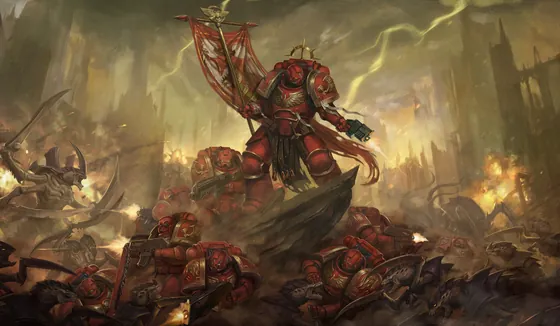
Waiting for him was Rogal Dorn, Praetorian of Terra. For years Dorn had turned the Emperor's Palace — once a sprawling city of gardens, spires and administrative wards — into the most formidable fortress humanity had ever built. Curtain walls rose kilometres high. Bastions bristled with void-shield generators, macro-cannon and lance batteries. Every gate was a killing ground. Dorn and his Imperial Fists, with the Blood Angels of Sanguinius and the White Scars of Jaghatai Khan, prepared to make the enemy pay for every metre.
Behind the walls, unseen by most defenders, the Emperor fought a war of His own. After Magnus the Red's ruinous psychic warning shattered the wards of the Emperor's secret webway project, daemons had flooded the tunnels beneath the Palace. The Master of Mankind was bound to the Golden Throne, holding back the tide with the full force of His mind, while Malcador the Sigillite and the Custodian Guard fought to keep the gate sealed. For most of the siege, the most powerful being in the galaxy could not leave His chair.Sanguinius, Lord of the Blood Angels, stood at Dorn's side knowing more than he would say. For years the Angel had been tormented by visions of his own death at the hands of Horus — a fate he had glimpsed across the Heresy, from Signus onwards. Rather than flee from it, he chose to defend the Palace knowing that the prophecy might well be fulfilled there. His presence on the walls, wings spread above the gun-lines, became the single greatest source of courage for the human soldiers who faced the onslaught.
The Forces
The defenders were outnumbered from the first day. Three Legions — the Imperial Fists, Blood Angels and White Scars — stood at the heart of the line, all of them already bloodied. Around them gathered the Custodian Guard, the Sisters of Silence, tens of millions of soldiers of the Imperial Army, the household troops of Terra's great families, Titan Legions such as the Legio Ignatum, and the loyalist remnant of the Mechanicum. Countless more were conscripts: clerks, labourers and refugees handed lasguns and told to hold a wall.
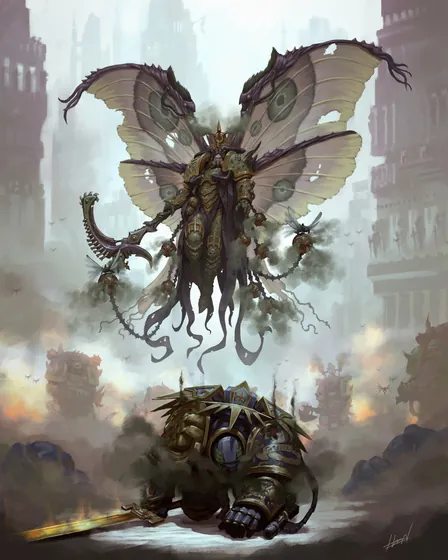
Against them came the Sons of Horus, the World Eaters, the Death Guard, the Emperor's Children, the Iron Warriors, the Night Lords, the Word Bearers and the Thousand Sons, together with the traitor Titan Legions of the Dark Mechanicum, Legio Mortis chief among them. Behind the Astartes marched an inexhaustible tide of mutant hordes, cultists and turned regiments — and, as the siege deepened and the walls of reality thinned, daemons in their millions. Several of the traitor Primarchs had by now been transformed into something more than mortal: Angron and Mortarion were daemons in all but name, and Fulgrim had already ascended.
Phases of the Siege
The war began in the void. In the Solar War, the traitor armada fought through Sol's outer defences, the gas-giant fortresses and Pluto's bastions, while the Iron Warriors and the Alpha Legion played their own deadly games of misdirection. The Imperial Fists fleet bled to buy time. When the traitor fleets finally reached Terran orbit, they unleashed a bombardment so vast that the skies over the Palace turned black with smoke and burning debris. Whole outer cities were reduced to glassed craters before a single traitor boot touched the ground.
The first landings struck the great spaceports that ringed the Palace. Perturabo, master of siegecraft, directed the opening assaults, testing Dorn's defences with methodical brutality. At the Lion's Gate spaceport the fighting reached a savagery few had witnessed. Mortarion led his Death Guard into the plains around it under a fog of plague and pestilent gases, and the Lion's Gate became a charnel field. Jaghatai Khan rode out with his White Scars to retake the port and met Mortarion in single combat. The duel was vicious and nearly fatal; the Khan was left so grievously wounded that he hovered close to death for much of the following siege.
Inside the outer walls the fighting fractured into a thousand smaller battles: the Saturnine Wall, the Anterior Barbican, the Colossus, the Mercury Wall. The World Eaters threw themselves at the bastions with no regard for losses, their warriors pouring over mounds of their own dead to reach the defenders. Iron Warriors siege engines pounded at gates night and day. In the streets below, conscript militia were massacred by the thousand and still the line held, because there was simply nowhere left to run. Dorn redrew his defence again and again, abandoning outer rings and burning what he could not hold.
As the months wore on, the warp itself began to bleed through. The traitor rituals — and the sheer weight of slaughter — tore holes in reality. Daemons walked openly in the Palace districts. Time grew strange; men saw ghosts and visions, and sanity buckled. The traitor Primarchs, increasingly lost to their patrons, fought as much for their own ends as for Horus. Perturabo eventually withdrew his Legion in disgust, and Mortarion and Fulgrim pursued their own appetites. Even so, by the final days the defenders were pressed back into the Inner Palace, and the Eternity Wall and the Delphic Battlement were all that stood between the enemy and the Sanctum Imperialis.
Aftermath
Rogal Dorn found the Emperor broken beside Horus's corpse, His body ruined beyond any hope of natural recovery. The Master of Mankind was carried back to the Palace and interred upon the Golden Throne, where He has remained ever since — neither living nor dead, sustained by the sacrifice of a thousand psykers a day. With Horus gone, the traitor host lost its single unifying will. The Legions fled Terra in disorder as the relief fleets of Guilliman, the Lion and Russ arrived.
The cost was beyond reckoning. The Imperial Palace lay in ruins; tens of millions had died on Terra alone. Sanguinius was dead and the Khan maimed. Dorn, haunted by the knowledge that he had not reached his father in time, would lead the Great Scouring that drove the traitors into the Eye of Terror. From the ashes of the siege, Guilliman would write the Codex Astartes and break the Legions into Chapters, and the Imperium would be remade around the worship of a silent, dying god.
Ten thousand years later, the Siege of Terra is still the founding wound of the Imperium. Every Blood Angel who dreams of the Angel's death, every Imperial Fist who stands a wall to the last, and every traitor who still curses the Emperor's name from the Eye of Terror is, in some way, still fighting that war.