Home › Great Battles › The Burning of Prospero
 1 / 3 · Click to enlarge
Background
Of all the tragedies of the Horus Heresy, few are as bitter as the Burning of Prospero, because the Legion that died there had not yet chosen to betray the Emperor. Magnus the Red, Primarch of the Thousand Sons, was a scholar and a sorcerer, the most gifted psyker among the Emperor's sons. His Legion had long been viewed with suspicion. Its warriors were all psykers, and its genetic stock had suffered a terrible flaw — the 'flesh-change', a mutation that warped Thousand Sons into monstrous shapes. Magnus had saved his Legion from extinction by delving deep into the powers of the warp, accepting bargains whose price he did not understand.
At the Council of Nikaea, the Emperor had ruled against the use of sorcery in His Legions. Magnus argued and lost, and returned to his homeworld of Prospero under a cloud. When he learned, through his own visions, of Horus's coming treachery, he chose to warn his father the only way he could: by hurling his mind across the galaxy through the warp, directly into the Imperial Palace on Terra.
The warning came at a catastrophic cost. Magnus's sorcerous projection smashed through the wards protecting the Emperor's secret project in the webway beneath the Palace, letting daemons pour into the labyrinth. Years of the Emperor's work were ruined in an instant, and Magnus's message was lost in the horror of his intrusion. The Emperor, furious, ordered Leman Russ of the Space Wolves to bring Magnus to Terra to answer for his crimes.
Before Russ reached Prospero, the order changed. Horus, already secretly in revolt, persuaded the Space Wolves' Primarch that Magnus was beyond redemption and must be destroyed. Russ — who had always distrusted the sorcerer-Legion — went to Prospero not as a jailer, but as an executioner.
Russ himself was no blind instrument. The Wolf King had argued with Magnus at Nikaea and had long warned that the Thousand Sons' arts would destroy them. When the new orders came, many in his court believed justice had simply arrived late. Few of the Wolves stopped to ask why the message had changed, or who had changed it. That question would only be answered after Tizca was ash.
The Forces
The Space Wolves came in strength, their great companies drawn together under the Wolf King himself. With them sailed a contingent of the Adeptus Custodes led by Constantin Valdor, Captain-General of the Emperor's guard, and the Sisters of Silence, the null-maiden warriors whose very presence dampened the powers of psykers. Together they represented the Imperium's answer to a Legion of sorcerers: brute force, incorruptible loyalty, and the soul-chilling void of the Blank.
The Thousand Sons should have been formidable defenders. Prospero was a world of learning and contemplation, but it was also the home of tens of thousands of psychic warriors, each capable of hurling fire or lightning with a thought. Its capital, Tizca — the City of Light — was crowned with great pyramids of glass and gold, its libraries holding knowledge gathered from across the galaxy. Yet when the Space Wolves arrived, Magnus did nothing. Burdened by guilt for the ruin he had caused on Terra, he believed he deserved punishment, and ordered that Prospero's defences remain lowered.
The Legion's psychic arts were organised into fellowships known as the Cults: the Pyrae, masters of fire; the Pavoni, who shaped flesh and blood; the Raptora, wielders of telekinetic force; the Corvidae, the seers; and the Athanaeans, readers of minds. Arrayed for war, they could level armies. Arrayed as Magnus ordered them — in shamed, silent acceptance — they were simply targets. Many Thousand Sons died without lifting a hand in their own defence, still trusting that their father knew what he was doing.
Phases of the Battle
The attack began from orbit. The Space Wolves fleet bombarded Prospero's defences, and drop pods and gunships fell upon Tizca like a storm of iron. The Sisters of Silence moved with the first waves, their null-presence sapping the psychic power of every Thousand Son they approached. Psykers who had once called down lightning found their minds smothered in silence as the Space Wolves fell upon them with bolter and axe.
For a time the Thousand Sons simply died. Their Primarch had forbidden resistance, and many of his warriors could not believe the Wolves had truly come to kill them. Tizca's streets became killing grounds. The Space Wolves, who had been bred and trained to be the Emperor's executioners, did their work thoroughly; great libraries were set ablaze, and the accumulated knowledge of millennia went up in smoke. Civilians fled in their hundreds of thousands, and many were killed in the crossfire or crushed in the collapse of burning buildings.
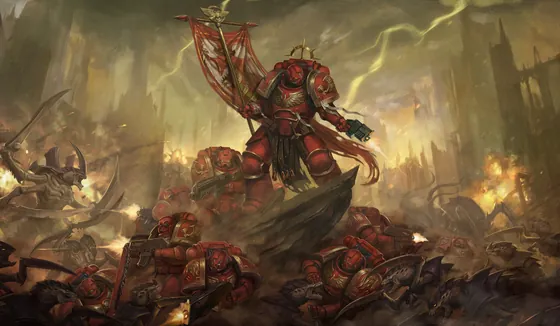
Eventually Azhek Ahriman, Chief Librarian of the Thousand Sons, broke with his father's passivity and rallied the Legion's survivors to fight. The Thousand Sons' sorcery, once unleashed, was devastating. Whole packs of Wolves were consumed by psychic fire or torn apart by telekinetic force. Fighting raged across the burning city, among the pyramids and through the ruined streets, as two Legions that had once fought side by side in the Great Crusade bled each other to ruin.
The Custodes and Sisters of Silence fought alongside the Wolves through the worst of it, and many of them died. Tizca's great pyramid, the Pyramid of Photep, became the epicentre of the fighting as the Wolves pressed in towards Magnus himself.
The fighting was ugly and close. Wolves tore through scriptoria and observatories, hacking robed scholars apart at their desks. Thousand Sons answered by boiling the blood inside armour and hurling warriors through walls of crystal and stone. Fenrisian wolves ran loose through the burning plazas, dragging down wounded psykers. Glass pyramids that had shone like suns cracked and fell in white-hot sheets onto the streets below. By night the whole of Tizca glowed from orbit, a city-sized pyre whose smoke blotted out the stars.
Aftermath
When the fires burned out, Prospero was a corpse. Tizca lay in ruins. The Thousand Sons had lost much of their Legion, and the survivors were left with no choice but to serve the Chaos God whose power had saved them. Ahriman would later cast the Rubric in a desperate bid to cure the flesh-change, turning most of his brothers into soulless dust trapped in armour — a second tragedy born from the first.
For the Space Wolves, Prospero was victory in name only. They had executed the Emperor's will, or what they believed it to be, but they had been manipulated by Horus into destroying a potential ally. Many Wolves fell there, and the enmity between the Space Wolves and the Thousand Sons became one of the deepest blood-feuds in the galaxy, lasting ten thousand years and counting.
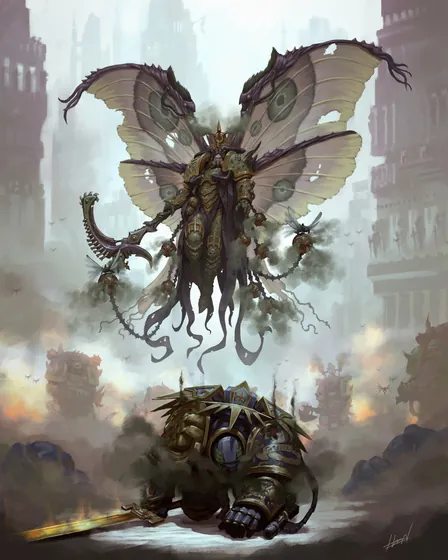
Magnus himself eventually embraced Tzeentch fully, becoming a Daemon Prince. In later ages he would return to Prospero, raising daemonic armies to take vengeance on the Space Wolves for the burning of his home. And on Fenris, the sagas of the Wolves still speak of the day the Wolf King broke the Crimson King across his knee — a tale they sing with pride, and a tale that many among the Imperium's scholars now read as one of its saddest.
Even within the Imperium, Prospero has never been comfortable history. Records of the burning were sealed, edited and in places erased. The Wolves themselves rarely speak of it outside their own halls. Yet the lesson the Imperium drew from it was not mercy but suspicion: that psykers, however loyal they claim to be, are always one bargain away from damnation — a belief that still sends witches to the Black Ships ten thousand years later.