Home › Great Battles › The Ullanor Crusade & Triumph
Background
Near the end of the Great Crusade, the Emperor's armies had reconquered much of the galaxy. World after world had been brought back into the light of the Imperium, xenos empires had been broken, and the Primarchs had been reunited with their father and given command of their Legions. But one great obstacle remained: a vast Ork empire centred on the world of Ullanor, ruled by the Overlord Urlakk Urg.
Urg's empire was the most powerful greenskin realm the Crusade had ever encountered. It sprawled across a whole sector, its hordes numbering in the countless millions, its war machines and crude starships a threat to every human world within reach. If it was left to grow, it could undo decades of conquest. The Emperor resolved to destroy it in one great campaign — and for the last time in the Great Crusade, He would take the field in person.
The Ullanor Crusade would be remembered as Horus's greatest victory while he was still loyal to his father. It was also, in hindsight, the high-water mark of the Imperium: the moment of greatest unity and hope before the long fall into civil war.
For Horus, the campaign was a chance to prove himself before his father and his brothers. He was the first of the Primarchs to be found, the Emperor's most trusted son, and the Luna Wolves were among the most celebrated Legions of the Crusade. Charismatic, brilliant and beloved by his warriors, Horus had already won countless victories. Ullanor would be the one that defined him.
The Forces
The Imperial host was enormous: some hundred thousand Space Marines, eight million soldiers of the Imperial Army and hundreds of warships, along with Titans of the Legio Mortis. Three Legions bore the brunt of the fighting. The Ultramarines under Roboute Guilliman and the White Scars under Jaghatai Khan were tasked with retaking the outlying worlds of the Ullanor system, while Horus and his Luna Wolves were given the honour of striking the central world itself.
Against them stood the Orks in their millions. Ork warbands of every clan and kind gathered around Urg's fortress-palace on Ullanor, a mountain of scrap metal and stone crowned by a towering central spire. Urg himself was a monster of an Ork, enormous even by greenskin standards, surrounded by a bodyguard of the biggest and most brutal warriors in his empire.
Orks are not like other enemies. They thrive on war, grow larger and stronger the more they fight, and follow whichever warlord is biggest and most brutal. An Ork empire on the scale of Urg's was held together by one thing: the Overlord himself. Remove him, and the whole structure would tear itself apart in a frenzy of infighting. Horus understood this better than anyone. He did not intend to grind the empire down world by world. He intended to kill its master.
Phases of the Campaign
Horus favoured a single, decisive strategy: strike at the enemy's head and the body will die. The Luna Wolves fleet drove straight for Ullanor while the other Legions cleared the outer worlds. Drop pods slammed into the ground all around Urg's fortress-palace. Heavy shuttles delivered Land Raiders and Predators, and armoured columns of Space Marines advanced on the defences, drawing hordes of Orks onto the perimeter walls.
That was exactly what Horus wanted. As the greenskins rushed to the walls, the Warmaster-to-be and a detachment of Terminators teleported directly to the foot of the great central tower. They blasted away the guards, and as the mobs from the walls began to stream back to protect their master, Horus led ten Terminators up the tower while the rest held the base against the returning horde.
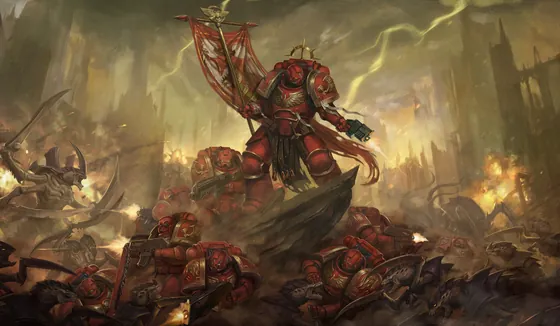
The fighting at the base of the tower was a meat-grinder. Terminators in heavy plate held the stairways and gates against tides of greenskins, their storm bolters and power fists turning the approaches into heaps of torn green flesh. The Orks came on regardless, as Orks always do, roaring and hacking at armour with crude cleavers and point-blank shootas. The Luna Wolves did not give ground.
On the outlying worlds, the Ultramarines and White Scars waged their own brutal campaigns. Guilliman's methodical, precise warfare and the Khan's lightning raids broke Ork strongholds one after another, preventing reinforcements from reaching Ullanor and tightening the noose around Urg's capital. Imperial Army regiments, many of them newly raised for the campaign, fought and died in vast numbers in trenches and ruined hive-shacks, holding ground against greenskin charges so the Legions could press forward. The void war above the sector was just as savage, with ramshackle Ork kroozers ramming Imperial warships and boarding parties fighting through blazing corridors.
The Triumph
With Urg dead, his empire fragmented. Imperial forces retook the sector within a year — though, as their allies noted with some irritation, the Luna Wolves claimed to have liberated far more worlds than anyone else. To celebrate what had become the greatest victory of the Crusade, the Emperor declared a Triumph on Ullanor.
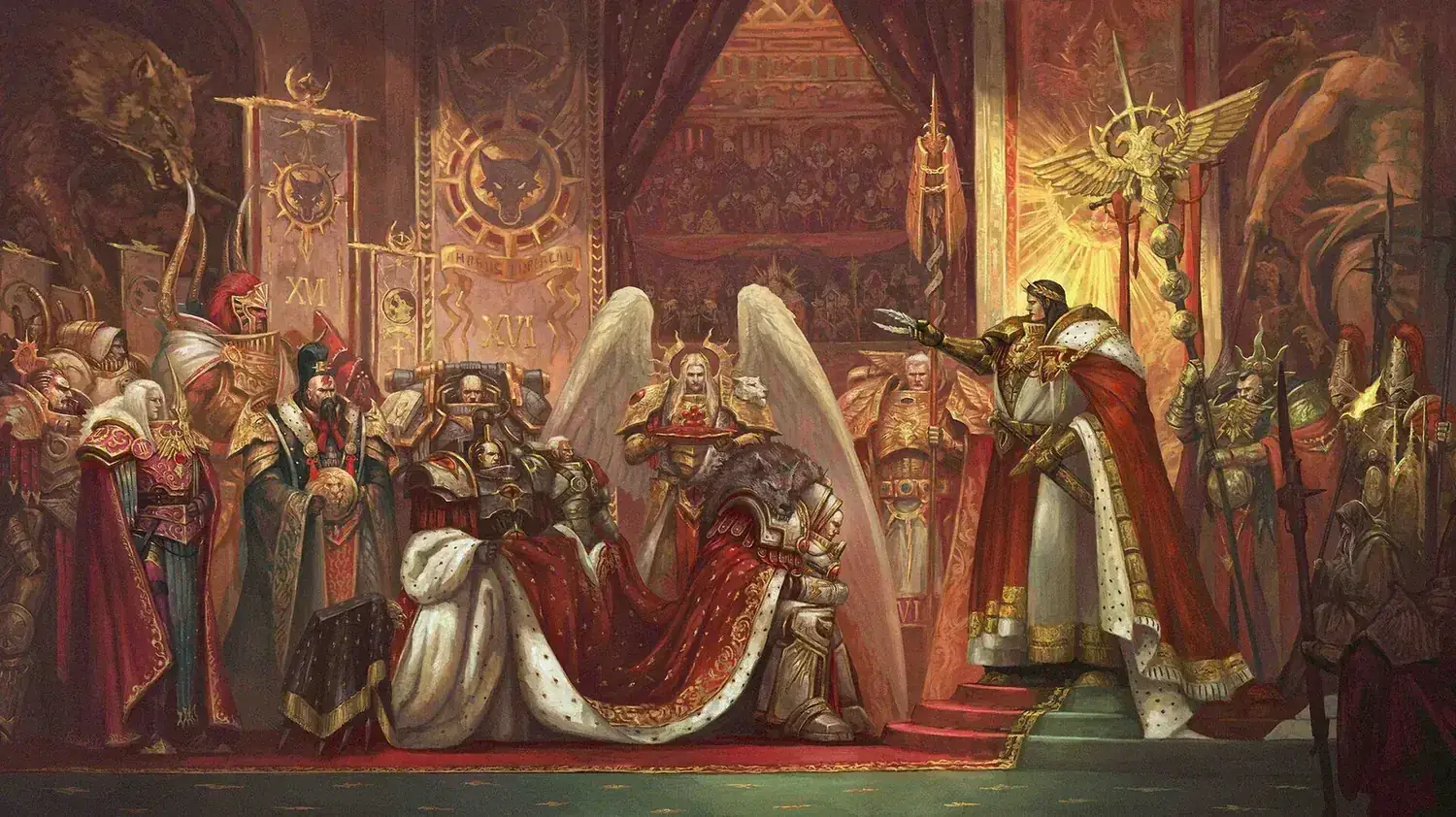
The preparations were staggering. The Mechanicum used geoformer engines and millions of servitors, prisoners and thralls to flatten an entire continent and lay a mirror-smooth granite road five kilometres wide and five hundred long. Its whole length was decorated with the skulls of slain Orks. At its end, on a mountaintop, stood a citadel where the Emperor sat with many of His Primarchs — Horus, Sanguinius, Mortarion, Magnus, Angron, Jaghatai Khan, Lorgar, Rogal Dorn and Fulgrim among them — together with Malcador, Constantin Valdor and the great lords of the Imperium, guarded by the Custodes, the Sisters of Silence and two gold-plated Warlord Titans.
Eight million soldiers of the Imperial Army marched along the road, followed by thousands of armoured vehicles and hundreds of Titans. Then came fourteen Space Marine Legions in their full glory, while thousands of aircraft darkened the sky. Horus came last of all, as the climax of the parade. And then the Emperor did something no one had expected. He named Horus Warmaster, commander of all His armies, and declared that the Luna Wolves would henceforth be known as the Sons of Horus. He announced that He would return to Terra, leaving the Crusade in His son's hands, and that all were to obey Horus as they would obey Him.
Not every Primarch received the news gladly. Some were proud of their brother; others resented being placed beneath him; a few were simply bewildered that their father would leave the war He had begun. Those small cracks of jealousy and doubt, barely visible on the day of the Triumph, would widen into chasms within a few short years.
Ullanor was the summit of the Great Crusade, and in hindsight it was also the cliff edge. Within a few years, the Warmaster crowned on that skull-paved road would turn against his father, and the Legions that marched in triumph across Ullanor would be killing each other on Isstvan, Calth, Prospero and finally Terra. Even the Orks would one day return: the warlord known as the Beast would later make Ullanor his own capital, before Ork power there was smashed once more. Ullanor remains the Imperium's brightest memory — and the beginning of its darkest age.
Long after the Heresy, veterans of the Black Legion would still speak of Ullanor — some with pride, and some with bitter regret for the brotherhood they had lost there.