Home › Great Battles › The Thramas Crusade
Background
In the chaos of the Horus Heresy, many of the most savage wars were fought far from Terra. One of the bitterest was the Thramas Crusade, a long, bloody campaign in the Eastern Fringe between two of the most feared Legions in the Imperium: the Dark Angels of Lion El'Jonson and the Night Lords of Konrad Curze.
Horus sent Curze's Night Lords to the Eastern Fringe to keep the Dark Angels away from his drive on Terra. They seized the forge worlds of Triplex, which had armed Rogal Dorn's forces, and fell on the Thramas Sector with massacres and atrocities designed to break the will of the Imperium's subjects. On the world of Thramas itself the people refused to kneel: when a Night Lords commander arrived to accept the planet's surrender, the captain-general of its Nightwatch shot him in the face, and the whole world rose in revolt. When the Lion finally brought his Legion to the Fringe, what followed was a war of manoeuvre, ambush and annihilation in which neither side gave quarter.
The two Primarchs were opposites in almost every way. The Lion was a knight from a world of monsters, a commander who valued secrecy, discipline and the rigid codes of his order. Curze was a creature of the night, raised alone in the lightless crime-city of Nostramo, who believed that fear was the only true law. Each saw in the other everything he despised, and the war between them became intensely personal.
The Forces
The Dark Angels were one of the largest and most technologically sophisticated Legions, with a vast fleet and arsenal of weapons. Their Primarch, the Lion, was a strategic genius whose cold, methodical approach to war made him one of the most dangerous commanders in the galaxy. Under him were many of the Legion's greatest warriors and orders.
The Night Lords were masters of terror and asymmetrical warfare. Their warriors wore armour marked with skulls and bat-wings, and they struck from darkness, killing and torturing to spread fear. At their head stood Konrad Curze, the Night Haunter, a Primarch tormented by visions of the future and driven by a twisted sense of justice. His First Captain, Jago Sevatarion — known as Sevatar — led the Atramentar, the Night Lords' elite Terminators, and was one of the most skilled warriors of the Heresy.
The Night Lords' methods were designed to make conventional warfare impossible. They broadcast the screams of their victims across vox channels; they flayed garrison commanders and left them hanging from the walls of their own fortresses; they struck at supply lines, shipyards and civilian populations rather than at enemy armies. Every world they visited was left as a warning. The Dark Angels, for their part, were masters of the methodical campaign. They secured systems one by one, kept their fleets concentrated and refused to be lured into traps.
The Dark Angels fielded the full panoply of their Legion: the heavy assault formations later remembered as the Deathwing, the swift Ravenwing, and the many specialised orders and fellowships that made up the First Legion's secretive culture. They were supported by a fleet strong enough to hunt the Night Lords across an entire sector. What they lacked was a way to force a fugitive enemy into the open.
Phases of the Crusade
The Dark Angels announced their arrival at Triplex Galatia, smashing the traitor Mechanicum fleet in orbit and storming the forge halls with the Deathwing. Deep in the forge-fanes, the Lion unleashed ancient Excindio war machines from the holds of his flagship, the Invincible Reason, and personally destroyed a multi-legged horror of brass and steel. Triplex fell, and the Lion began to drive the Night Lords back world by world. But the Night Lords would not stand and fight. They threw slave armies at the Dark Angels and slipped away, and the war ground into a stalemate across four sectors.
At the end of 008.M31 Curze gathered some hundred thousand of his warriors and struck back across half a dozen worlds. At Crucible the Night Lords made a combat drop against a heavy Dark Angels defence line — until Curze broke from the battle plan and rampaged off on his own. At that moment the Lion appeared, turned his Excindio loose on Curze to pin him, and fell on the scattered Night Lords commanders with his Deathwing Companions. Then the traitor White Scars who had joined the Night Lords turned on their allies. Curze had to be dragged from the field, screaming for the Lion to face him, and three-quarters of the Night Lords at Crucible died in the rout.
The Lion then struck at Thramas, now besieged by Ulan Huda, a predator-moon controlled by a Dark Magos called the Witch of Thramas. The Invincible Reason ripped through the traitor fleet and boarded the moon. While the White Scars sacrificed themselves to destroy its generators, the Lion carved his way to its heart and cut down the Witch with his own sword when not even Dreadnoughts could stop her.
The decisive blow came at Sheol IX. The Lion deliberately created a gap in the loyalist lines, and the Night Lords fleet poured into it. Hundreds of Dark Angels capital ships suddenly appeared among them, many caught at anchor, and the slaughter that followed was cold and precise. The Dark Angels stormed Curze's fortress on the surface and, in two hours of fighting, the Night Lords lost a quarter of their entire Legion. The Night Lords sacrificed a whole company to recover their wounded Primarch, and the flagship Nightfall escaped only when another Night Lords ship blew up its own reactors to open a path.
With Curze in a coma, Sevatar took command of the broken Legion, executing the rival captains Kuln and Herec who challenged him. At Qetesh the Dark Angels caught the Night Lords again, and Sevatar planned a near-suicidal rearguard to let the rest of the Legion escape. Then Curze woke and ordered a final gamble: a hundred Atramentar and seven hundred Night Lords teleported aboard the Invincible Reason with their Primarch.
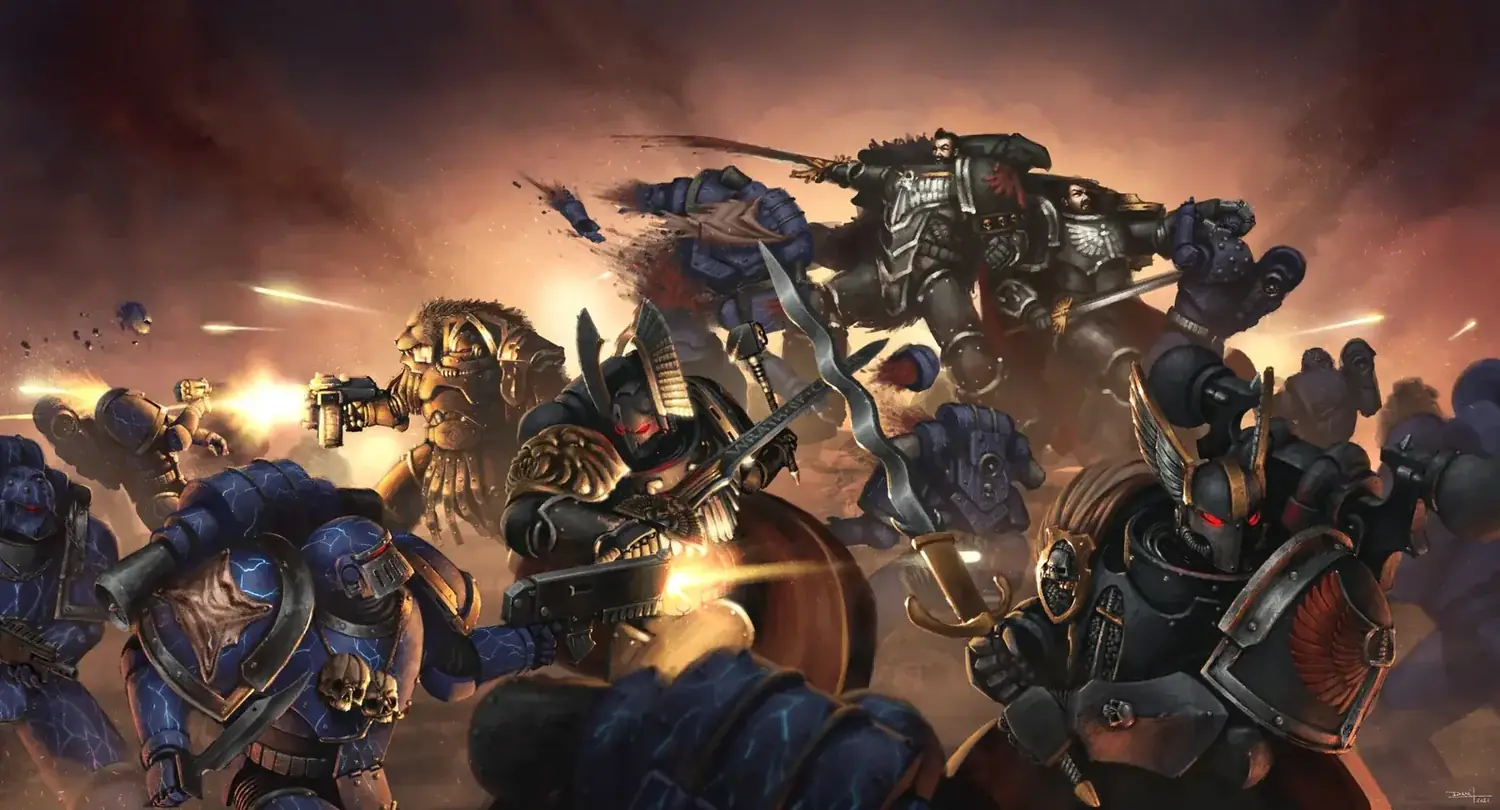
The Qetesh assault was butchery in the dark. Dark Angels squads were ambushed in corridors and hacked apart, but the flagship was vast and the Lion's sons were not easily terrorised. The boarders were surrounded and overrun. The Atramentar fought until their armour was split open by power swords and plasma, and corridor after corridor became a tomb of shattered blue and black ceramite. Only Sevatar and about a dozen Atramentar survived, and they were taken prisoner.
Aftermath
The Thramas Crusade ended with the Night Lords shattered: perhaps half their Legion dead and most of their fleet destroyed or captured. They scattered into raiding warbands for the rest of the Heresy. But Curze survived, and Horus had achieved what he wanted — the Dark Angels had been kept far from Terra. The Lion, weary and melancholy, judged the campaign neither a victory nor a defeat, and took his Legion to Ultramar, where he became entangled in the politics of Imperium Secundus.
The Lion's own losses were real. Night Lords raids destroyed ships and killed Dark Angels across the sector, and the region's worlds were left devastated; billions of civilians died. Some worlds were so traumatised by the Night Lords that they never recovered. The Lion's methodical approach eventually won the war, but it was a costly victory.
The war was a reminder of how brutal the Heresy could be, even away from its most famous battles. It also left lasting scars on both Legions. For the Night Lords, it was another chapter in a history of terror and failure. For the Dark Angels, it was a war that tested the Lion's genius and the loyalty of his sons.
The Thramas Crusade remains a favourite subject among those who study the Heresy because it shows the war in its purest, most savage form: two Legions whose strengths and weaknesses mirrored each other, fighting for years without witnesses, mercy or rules. It also shows the strange relationship between the Lion and his darker brother — two Primarchs who, in their own ways, believed they were serving justice, and who were willing to commit horrors in its name.
Curze himself never found peace. After the Heresy, he went on to meet the fate he had long foreseen, killed by an Imperial assassin sent to end him. Sevatar's story was not over either, but it would be written in the dungeons of the Dark Angels rather than on the battlefield. And the hatred between the First Legion and the Eighth would outlast both of their Primarchs.
The Thramas Crusade is remembered as one of the strangest and cruellest campaigns of the Heresy: a war fought less with battle lines than with terror, ambush and the slow grinding-down of two Legions in the dark. Neither the Lion nor Curze emerged from it unchanged, and the hatred between their sons outlived them both.