Home › Great Battles › The Wars for Armageddon
Background
Armageddon is a hive world of choking industry, toxic ash wastes and steaming equatorial jungles, one of the great manufacturing centres of the Imperium. Its hive cities produce weapons, vehicles and armour for armies across the segmentum. In the 41st Millennium, it became the site of the largest and most famous wars ever fought against the Orks — wars dominated by two legendary figures: Ghazghkull Mag Uruk Thraka, the prophet of the Ork gods, and Sebastian Yarrick, the old man of Armageddon.
Ghazghkull was no ordinary warboss. A head wound received in battle had been repaired with an adamantium plate, and afterwards he claimed to hear the voices of Gork and Mork, the Ork gods. Whether his visions were real or not, Ghazghkull had a strategic mind unlike any other Ork, uniting countless tribes under a single banner. He chose Armageddon as his target precisely because it was so important to the Imperium.
Armageddon had suffered before. In the First War for Armageddon, centuries earlier, the Daemon Primarch Angron had led an army of Khorne into the planet, and it had taken the Grey Knights and the Space Wolves to drive him out. The Imperium's response to that war — the purging of witnesses and the suppression of the truth — had left a bitter legacy. When Ghazghkull came, Armageddon was a world that had already learned the price of survival.
The Forces
In the Second War, Armageddon was defended by its own planetary forces — the Armageddon Steel Legion — under the command of Overlord Herman von Strab, a vain, incompetent aristocrat. When Ghazghkull's space hulk appeared in the system, von Strab dismissed the threat and banished the troublesome Commissar Yarrick to Hades Hive for warning him otherwise. The result was disaster.
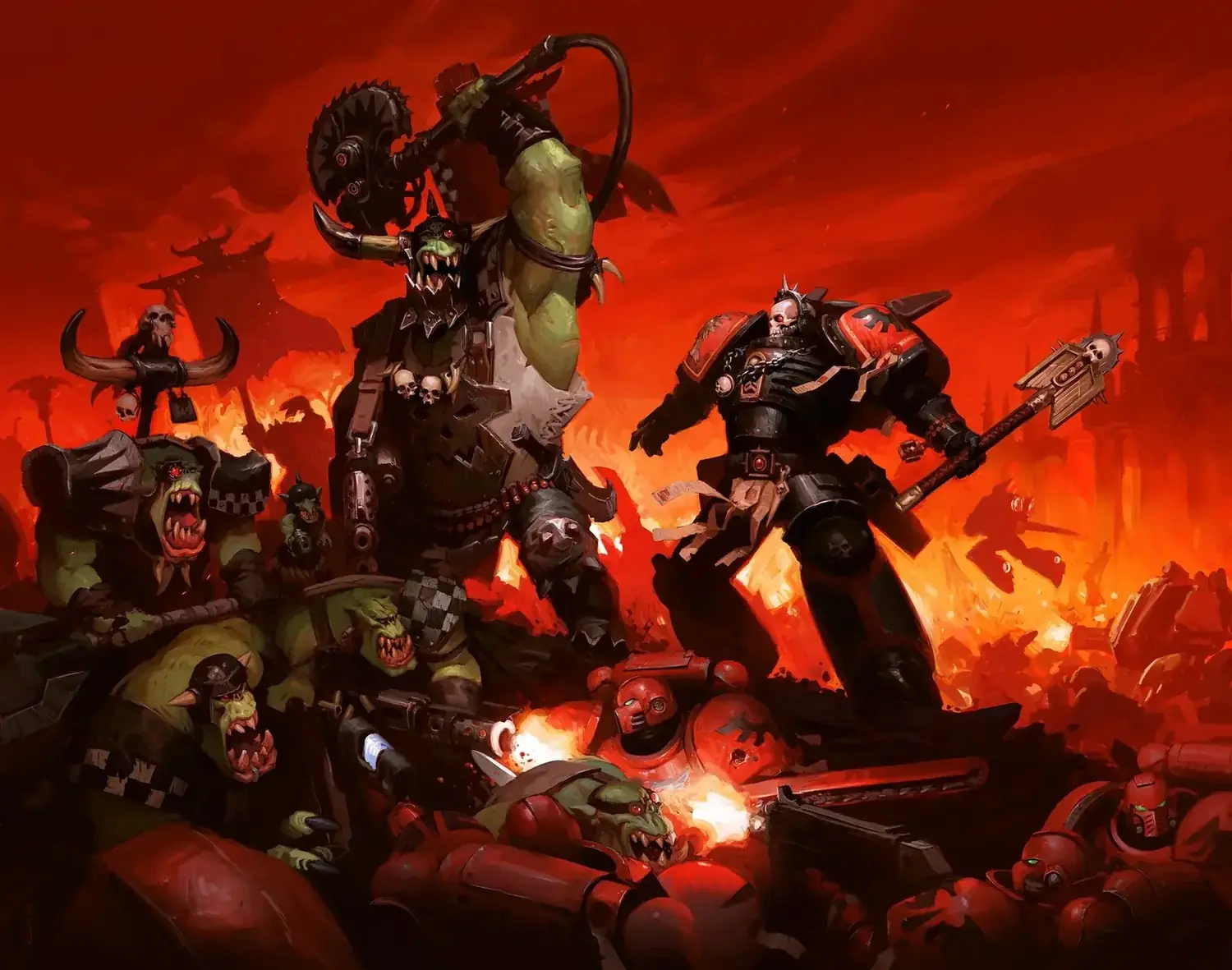
Ghazghkull's Waaagh! came in a tidal wave: hundreds of thousands, perhaps millions of Orks, Gargants, Stompas, Speed Freeks and every imaginable form of crude, brutally effective Ork weapon. The greenskins smashed through the planet's defences and swept across Armageddon Prime, overrunning hives and destroying entire regiments of the Steel Legion. Von Strab fled; the planetary leadership collapsed.
The Steel Legion itself was a formidable force when properly led: a mechanised army that rode to war in Chimera transports, its soldiers clad in greatcoats and rebreather masks against the poisoned air of the ash wastes. Its regiments had been raised in the hives' endless foundries and drilled for war against exactly this kind of enemy. Under von Strab they were squandered. Under Yarrick they would become legends.
Phases of the Wars
Hades Hive became the centre of the Imperial resistance. Yarrick took command of the defence and held the hive for months against overwhelming odds. The Orks attacked again and again, and the fighting reduced Hades to rubble. Yarrick was badly wounded in the struggle, losing an arm in the fighting — and, in the grim style that made him a legend, he later took an Ork warlord's power klaw for his own. His refusal to surrender gave hope to millions and bought precious time for the Imperium to respond.
The siege of Hades was a nightmare of industrial slaughter. Orks swarmed through the outer levels of the hive by the thousand, and every corridor, manufactorum and hab-block became a battlefield. Defenders fought in darkness, with ammunition running low, while Gargants pounded the hive's walls from outside. Hive-workers were armed and thrown into the line beside Steel Legion survivors. Yarrick was everywhere — on the walls, in the tunnels, in the command bunkers — and his presence held the defence together long after it should have collapsed.
The relief came from the Adeptus Astartes. Commander Dante of the Blood Angels took command of the Space Marine forces, joined by Marneus Calgar and the Ultramarines and Tu'Shan with the Salamanders. Their arrival turned the tide. The Space Marines launched devastating counterattacks across Armageddon, while the Salamanders under Tu'Shan rallied Imperial defenders and held a vital bridge over the River Stygies against a massive Ork assault.
Gradually the Waaagh! was broken. The Space Marines and the remaining Imperial forces drove the Orks back, and Ghazghkull's hordes began to collapse. Ghazghkull himself escaped Armageddon, but his Waaagh! had been defeated. Ork remnants would continue to fight for decades in the jungles and ash wastes of the planet, but the Second War was won.
Ghazghkull returned. In 998.M41, he launched another invasion, larger and more cunning than the first. This time the Orks attacked with even more power, including Ork rocks and space hulks, and Ghazghkull's strategy was far more sophisticated. The Third War for Armageddon became one of the greatest conflicts of the age.
Yarrick, now old but still unbroken, took command of the defence. He had studied Ghazghkull for decades and understood the Ork warlord better than any other human. The Imperium poured reinforcements into Armageddon: Steel Legion regiments, Space Marine Chapters including the Black Templars under High Marshal Helbrecht, the Salamanders, the Blood Angels and many more, Titans, Imperial Navy fleets and others.
The opening months were a whirlwind of invasion. Ork landings struck across the planet at once, and space hulks and asteroid fortresses filled the skies. Yarrick's defenders, better prepared than in the Second War, fought a war of movement and counterattack rather than simply waiting behind hive walls. The war became a grinding stalemate. Hive cities were besieged, the ash wastes were turned into battlefields of colossal scale, and Orks and Imperial forces fought across every continent. Neither side could deliver a decisive blow. Eventually Ghazghkull left Armageddon to continue his campaigns elsewhere, but the war on the planet continued. For the Steel Legion and the Imperial forces, Armageddon became a permanent war zone.
Aftermath
Armageddon became a symbol of the Imperium's endless wars. The Second War showed how heroism and determination could defeat an overwhelming enemy. The Third War showed how the galaxy's wars could become endless struggles without clear victory.
The cost of the wars is beyond calculation. Millions of Steel Legion soldiers and Imperial citizens died in the Second War alone, and the Third War consumed millions more. Whole hives were reduced to rubble. The ash wastes became graveyards of Titans, tanks and Gargants. For Armageddon's people, war became the ordinary condition of existence — the planet's manufactoria kept working to feed the very war that was destroying them.
Yarrick became one of the most famous heroes of the Imperium, and his rivalry with Ghazghkull one of the most legendary of the 41st Millennium. Ghazghkull, meanwhile, went on to further conquests, becoming one of the most dangerous Orks in the galaxy. And Armageddon remained a battlefield, its ash wastes and hives scarred by decades of war.
To this day, the Imperium speaks of Armageddon as a world that refused to die. Yarrick's name is spoken with reverence across the Segmentum, and Ghazghkull's name is spoken with dread. Between those two names lies one of the longest, bloodiest wars of the 41st Millennium — a war that, for the soldiers in its trenches, never truly ended.
Few worlds have bled as long or as often as Armageddon. Its hive cities are scarred by generations of war, its ash wastes littered with the wrecks of tanks and Gargants from every conflict, and its people raised from birth knowing that the Orks will come again. Yet the planet endures, and its defenders still hold the line.